
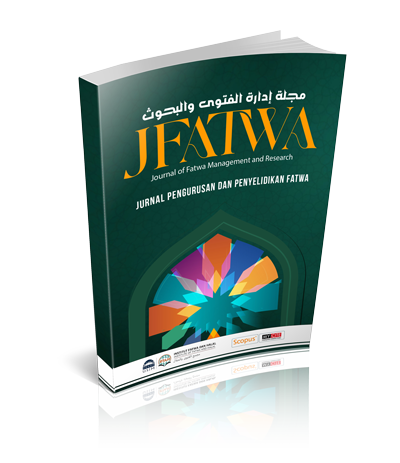
About the Journal

Journal title Jurnal Pengurusan Dan Penyelidikan Fatwa
Journal of Fatwa Management and Research
Initials JFATWA
ISSN 2232-1047 (Printed)
eISSN 0127-8886 (online)
Frequency January, May and September
DOI Prefix 10.33102/jfatwa- Crossref linked
Editor-in-chief Professor Dr. Azman Ab Rahman, Universiti Sains Islam Malaysia, Malaysia
Managing Editor Dr. Hussein 'Azeemi Abdullah Thaidi , ChM Dzulfadli Rosli , Universiti Sains Islam Malaysia, Malaysia
Publisher USIM Press
Citation Analysis  Scopus | Google Scholar 
Peer Review Double Blind Review


JURNAL PENGURUSAN DAN PENYELIDIKAN FATWA (JFATWA), also known as The Journal of Fatwa Management and Research, engages a broad readership with its interdisciplinary approach to all vital themes related to Fatwa and Halal research. The journal examines issues that cross both academic and international frontiers, showcasing research with wide-reaching implications. Guided by a distinguished editorial board and selected peer reviewers, JFATWA is committed to fostering essential, contemporary dialogues in the fields of Fatwa and Halal studies. It eagerly invites innovative ideas and research directions in related areas.

Beginning January 1, 2022, JFATWA is published three times a year by the Institut Fatwa dan Halal (IFFAH) at Universiti Sains Islam Malaysia (USIM).  The journal stands as a crucial resource for scholars, regulatory authorities, and experts in Syariah, Fatwa, and Halal fields. The journal's editorial team is dedicated to fostering an environment of open and rigorous discourse and invites contributions from various disciplines. These contributions may employ different research methodologies and originate from diverse global perspectives. The journal also encourages the submission of original works in Malay, English, and Arabic, which must be previously unpublished and not under consideration by other publications.

Authors are encouraged to submit manuscripts relevant to the scope of JFATWA. It is crucial to familiarize yourself with our peer-review process; articles undergo a rigorous double-blind review to maintain the highest standards of scholarly integrity. Acceptance of manuscripts is contingent upon the recommendations of peer reviewers and the final approval of the Editorial Board. Additionally, authors must adhere strictly to the author guidelines and manuscript template provided on our website. Submissions that do not conform to these guidelines or that deviate from the specified format will be rejected by the editorial team prior to review. Only manuscripts that meet these formatting standards will be considered for publication. The electronic manuscript submissions can be uploaded via https://jfatwa.usim.edu.my/index.php/jfatwa/submission/wizard

Manuscripts and any related correspondence must be submitted to the Editor-in-Chief through our online submission system (OJS). This journal utilizes the LOCKSS and CLOCKSS archival systems, hosted by Stanford University Libraries in the United Kingdom, under the PKP Private LOCKSS and CLOCKSS Network program. To uphold the highest community standards in archival practices, JFATWA conforms to the Sherpa Romeo archiving standards.

Announcements

Revised Article Processing Charges (APC) for JFATWA

27-05-2025

JAFTWA remains fully committed to open access: every article we publish is immediately and permanently free for readers worldwide. To preserve this model while upholding the highest publishing standards, we are revising our Article Processing Charges (APC). All articles accepted after 1 June 2025 will be subject to the revised APC, as follows:

RM1,900 (main/corresponding author based in Malaysia)

USD450 (main/corresponding author based outside Malaysia)

These fees are invoiced only after a manuscript has successfully completed peer review and been formally accepted; there are no charges at the point of submission, and the double-blind review process remains entirely independent of any payment considerations.

The APC underwrites the essential functions that keep JFATWA credible and accessible. It sustains a rigorous peer-review system in which manuscripts are assessed by subject-area specialists and every editorial decision is recorded transparently, safeguarding scholarly integrity from submission to publication. It also covers professional journal production and comprehensive metadata enrichment that maximise global discoverability. Also, the fee supports secure online hosting on the latest OJS platform with frequent backups, perpetual digital archiving for long-term accessibility, and the creation of full XML and HTML versions to ensure wider indexing and seamless machine readability across research databases. Finally, the APC enables us to maintain a skilled technical team that oversees day-to-day operations and ensures reliable support for authors and reviewers throughout the publishing process.

We thank our authors, reviewers and readers for their continued support and look forward to publishing high-impact research that advances Shariah, fiqh, fatwa and halal studies.

— JFATWA Editorial Office

Read more about Revised Article Processing Charges (APC) for JFATWA

Current Issue

Vol. 31 No. 3 (2026): September Issue

The September 2026 Issue showcases a rich spectrum of research papers authored and co-authored by scholars affiliated with leading institutions across six countries: Malaysia, Indonesia. Pakistan, Ethiopia, Morocco, Thailand.

Published: 30-09-2026

Articles

  • ARTIFICIAL INTELLIGENCE IN NOVEL FOOD INNOVATION: APPLICATIONS AND IMPLICATIONS FOR HALAL COMPLIANCE

    Noriah Ramli, Bilal Hussain
    :1-11
    DOI: https://doi.org/10.33102/jfatwa.vol31no3.785

  • ANALISIS SISTEM PENGURUSAN KUALITI BERASASKAN SYARIAH (MS 1900) DARI PERSPEKTIF TADBIR URUS DAN PERUNDANGAN DI MALAYSIA

    Tahirah Mohamed, Suhaizad Saifuddin
    :12-31
    DOI: https://doi.org/10.33102/jfatwa.vol31no3.788

  • MUSABAQAH TILAWAH AL-QUR’AN (MTQA) DALAM EKOSISTEM INDUSTRI KONTEMPORARI: ANALISIS DINAMIKA KEPERLUAN PANDUAN FATWA

    Ahmad Shafiq Mat Razali; Mohd Isa Hamzah, Hafizhah Zulkifli; Muhamad Nasir Mohamad Salleh
    :32-49
    DOI: https://doi.org/10.33102/jfatwa.vol31no3.809

  • PENILAIAN EKSPERIMENTAL RALAT MAKLUMAT JANAAN KECERDASAN BUATAN BERASASKAN SET DATA KEFATWAAN

    Mohammaddin Abdul Niri, Noor Naemah Abdul Rahman, Mohd Anuar Ramli
    :50-72
    DOI: https://doi.org/10.33102/jfatwa.vol31no3.821

  • PEMBANGUNAN STANDARD MAKANAN AKUAKULTUR HALAL: DARIPADA PENDEKATAN PEMATUHAN KEPADA PENGURUSAN RISIKO HALAL

    Nurulaina Saidin, Mohd Ashrof Zaki Yaakob, Zulaipa Ruzulan, Hanifah Musa Fathullah Harun
    :73-90
    DOI: https://doi.org/10.33102/jfatwa.vol31no3.868

  • JURANG PENYAMPAIAN FATWA IBADAH KEPADA PESAKIT HEMODIALISIS DI MALAYSIA: ANALISIS EMPIRIKAL DAN CADANGAN PEMBAHARUAN MEKANISME INSTITUSI FATWA

    Zahin Mohamad Tahir, Arieff Salleh Rosman, Khadijah Mohd Husni, Raja Nurul Ain Raja Nazol Azhar, Muhammad Aiman Abdull Rahim, Ahmad Safwan Yunos
    :91-115
    DOI: https://doi.org/10.33102/jfatwa.vol31no3.886

  • EVOLUSI KONSEP ISTIḤĀLAH DALAM FATWA MALAYSIA (2000-2025): ANALISIS KANDUNGAN FATWA HALAL DAN PERUNDANGAN ISLAM DALAM PRODUK FARMASEUTIKAL

    Muhammad Adib Samsudin, Mohd Nasran Mohamad, Muhammad Zaini Yahaya, Anwar Fakhri Omar, Muhammad Aliif Fadzilah, Jarudin
    :116-133
    DOI: https://doi.org/10.33102/jfatwa.vol31no3.909

  • WHAT DRIVES URBAN MUSLIM MILLENNIALS TO VIRAL CONCEPT RESTAURANTS?

    Azreen Jihan Che Mohd Hashim, Nor Asiah Omar, Nur Shuhada Kamarudin, N. Alia Fahada W. Ab Rahman, Muhamad Azrin Nazri, Muhammad Majid, Popon Srisusilawati
    :134-157
    DOI: https://doi.org/10.33102/jfatwa.vol31no3.743

  • THAI HALAL FOOD: HISTORY, CULTURE, AND MUSLIM TOURISTS’ EXPERIENCES IN THAILAND

    Nawawee Arawan, Rushdy Thaokloy, Hartinee Cheming
    :158-172
    DOI: https://doi.org/10.33102/jfatwa.vol31no3.835

  • DIVERSITY IN HALAL FATWAS ON MAGGOT UTILISATION FOR FOOD APPLICATION IN THE HALAL INDUSTRY

    Fahmi Hasan Nugroho, Annisaa Hakim, Mayang Sri Rahayu, Raihan Anugerah
    :173-188
    DOI: https://doi.org/10.33102/jfatwa.vol31no3.851

  • BRIDGING INSTITUTIONAL GAPS IN ZAKAT DISTRIBUTION FOR FINANCIAL RESILIENCE: ADDRESSING RISING INDEBTEDNESS IN ISLAMIC FINANCIAL INSTITUTIONS

    Siti Mazlita Yamaludin, Mohd Rahim Khamis, Sharifah Faigah Syed Alwi, Mohd Suffian Mohamed Esa, Azman Abd. Rahman
    :189-209
    DOI: https://doi.org/10.33102/jfatwa.vol31no3.864

  • TOWARDS MAQASID SHARIAH-ALIGNED ICT GOVERNANCE: A SYSTEMATIC REVIEW OF DATA SOVEREIGNTY AND DATA SAFETY IN MALAYSIA

    Nur Ilyana Ismarau Tajuddin, Nurafifah Mohd Nor, Norita Md Norwawi, Nur Aina Abdullah
    :210-235
    DOI: https://doi.org/10.33102/jfatwa.vol31no3.891

  • TOWARD THEOCENTRIC ENTREPRENEURSHIP: THE TAWADHU FRAMEWORK FOR VALUE-BASED GOVERNANCE IN A PESANTREN ECOSYSTEM

    Budiyono Santoso; Eko Suprayitno; Ahmad Djalaluddin, Fuadah Johari
    :236-257
    DOI: https://doi.org/10.33102/jfatwa.vol31no3.895

  • MALAYSIA’S HALAL INDUSTRY: A SYSTEMATIC REVIEW OF SCOPUS-INDEXED STUDIES

    Muhammad Najib Mohd Amin, Zamzulaila Zakaria, Nor Hafizah Zainal Abidin
    :258-273
    DOI: https://doi.org/10.33102/jfatwa.vol31no3.897

  • FAKTOR YANG MEMPENGARUHI NIAT PEMBELIAN PRODUK HALAL SECARA PLATFORM E-DAGANG DALAM KALANGAN PELAJAR MUSLIM UITM

    Azarudin Awang, Hisam Satari, Mohammad Syukri Ab. Jalil , Nasif Sidquee Pauzi
    :274-292
    DOI: https://doi.org/10.33102/jfatwa.vol31no3.834

  • ANALISIS PERBANDINGAN SKIM PENGAGIHAN ZAKAT INSTITUSI PENGAJIAN TINGGI MALAYSIA MENURUT MAQASID SYARIAH

    Azman Ab Rahman, Muhammad Azhad Al-Bohari, Mushaddad Hasbullah, Hairunnizam Wahid
    :293-317
    DOI: https://doi.org/10.33102/jfatwa.vol31no2.881

  • DEVELOPING SHARIAH ACCOUNTABILITY FRAMEWORK FOR ARTIFICIAL INTELLIGENCE IN HEALTHCARE USING THE FUZZY DELPHI METHOD

    Ahmad Safwan Yunos, Muhammad Danial Hakimi Nor Shaifulizam, Mohammad Naqib Hamdan, Zahin Mohamad Tahir
    :318-322
    DOI: https://doi.org/10.33102/jfatwa.vol31no3.822

  • DIFFERENCES BETWEEN MUI AND LBM NU FATWAS ON THE SUITABILITY OF SACRIFICIAL ANIMALS INFECTED WITH FOOT AND MOUTH DISEASE (FMD) VIRUS IN INDONESIA

    Nur Solikin, Hilmi Ridho, Nur Rohman, Wahyudi, Alfi Qonita Badi'ati , Khoirul Anwar, Afif Sabil
    :333-355
    DOI: https://doi.org/10.33102/jfatwa.vol31no3.765

  • BETWEEN RU’YAH AND TECHNOLOGY: OPERATIONALISING A FIQH–ASTRONOMY FRAMEWORK FOR SHARIAH-COMPLIANT DIGITAL HILAL VERIFICATION

    Khairussaadah Wahid, Mohd Saiful Anwar Mohd Nawawi, Nazhatulshima Ahmad, Riza Afrian Mustaqim
    :384-402
    DOI: https://doi.org/10.33102/jfatwa.vol31no3.879

  • KOMPAUN SEBAGAI INSTRUMEN PENGUATKUASAAN UNDANG-UNDANG SYARIAH: ANALISIS PELAKSANAAN TERHADAP KESALAHAN-KESALAHAN DI BAWAH ENAKMEN UNDANG-UNDANG KELUARGA ISLAM NEGERI PERLIS

    Mohd Husni Za’im Mohd Said, Jasni Sulong, Mohd Mahyeddin Mohd Salleh
    :403-420
    DOI: https://doi.org/10.33102/jfatwa.vol31no3.833

View All Issues